[ad_1]
India and the United States have finalised a long-negotiated trade agreement, with US President Donald Trump announcing that Washington will cut tariffs on Indian goods to 18 per cent with immediate effect, down from earlier elevated levels. The pact follows months of negotiations aimed at easing trade tensions and stabilising bilateral economic ties.
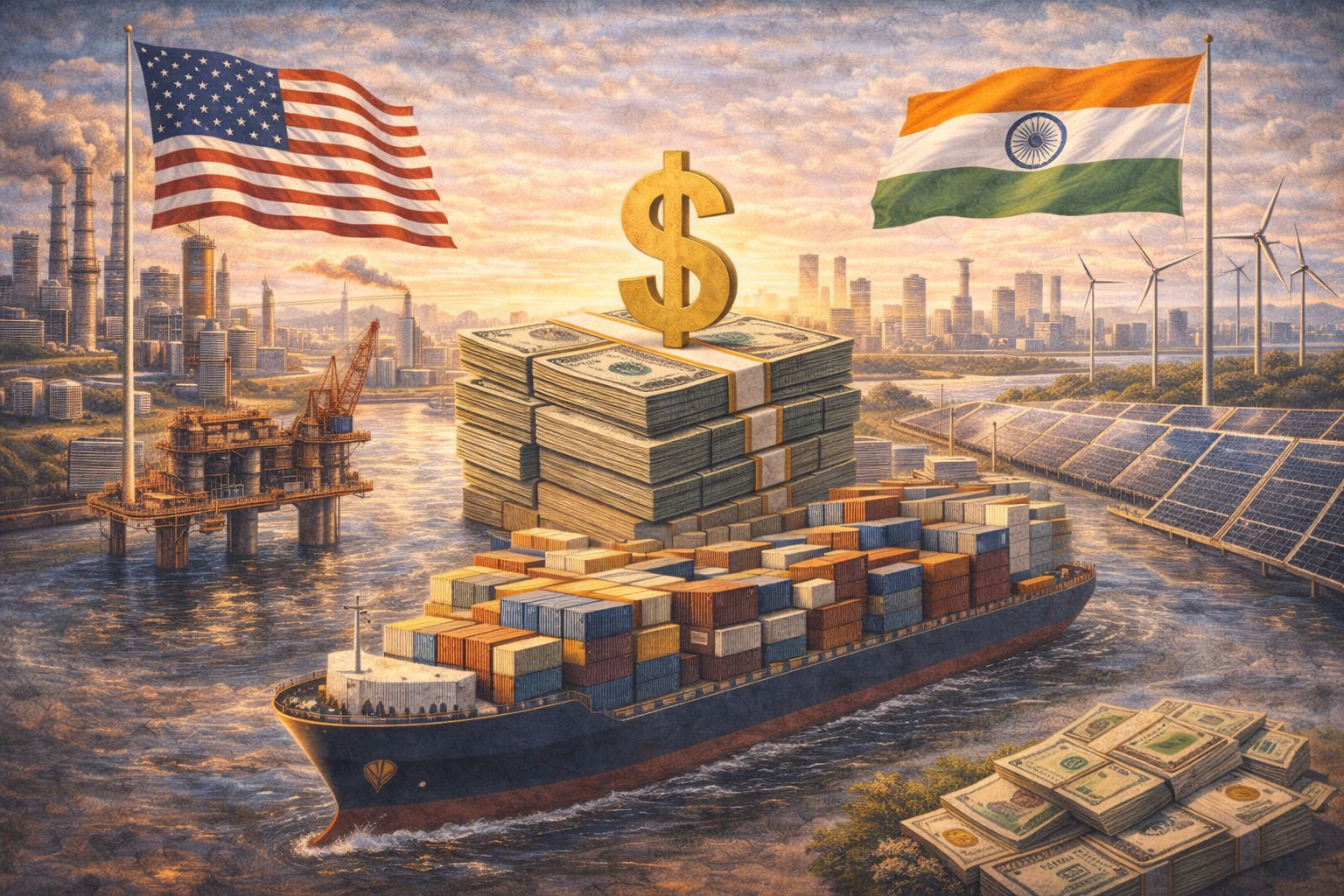
The agreement comes after India addressed several US concerns through policy adjustments and stepped up efforts to expand trade partnerships with other global economies. As part of the broader understanding, Trump indicated that India would scale back purchases of Russian oil while increasing imports of US energy, agricultural commodities, coal and other products, potentially amounting to $500 billion in trade flows.
The tariff relief comes at a time when External Affairs Minister S Jaishankar is scheduled to visit the United States for discussions with American officials, with a key focus on critical minerals cooperation.
Union Minister for Commerce and Industry Piyush Goyal recently said both countries are working to conclude the broader trade agreement at the earliest, reflecting renewed momentum in bilateral negotiations.
“Every free trade agreement stands on its own legs. And we are having very good negotiations. My counterpart in the US and I have a very wonderful working relationship and a wonderful personal friendship. We are working towards closing the deal quickly,” Goyal told PTI.
Turbulent backdrop shapes negotiations
The renewed engagement between the two countries comes after a period of heightened friction in trade and energy relations. The United States had sharply increased tariffs on Indian goods, with duties rising to 27 per cent and threats of escalation to 50 per cent. At the same time, Washington imposed additional penalties of 25 per cent linked to India’s continued purchase of Russian crude oil, placing New Delhi under pressure amid volatile global geopolitical conditions.
The dispute emerged as India relied on discounted Russian crude supplies, which conflicted with US demands to diversify sourcing. The tensions significantly narrowed India’s trade surplus with the United States and raised concerns about further escalation if corrective measures were not undertaken.
PM Modi’s US visit
Modi visited Washington, DC, on February 13, 2025, meeting President Trump to discuss strengthening bilateral ties across trade, defense, technology, energy, security, and people-to-people relations. Analysts described the visit as signaling continued positive momentum in US-India relations despite tariff differences, helping elevate India as a key partner.
India had previously reduced duties on US motorcycles before the visit, with further cuts announced jointly during or right after the trip on February 13.
Discussions between the two leaders directly addressed US concerns over India’s Russian oil purchases. President Donald Trump had publicly indicated his dissatisfaction over India’s energy sourcing strategy, while both sides used the visit to explore pathways to de-escalate trade tensions and strengthen economic cooperation.
India-US LPG deal emerges nine months post-Modi visit
India finalised a one-year structured contract with the US for import of 2.2 MTPA of LPG from the US Gulf Coast. Under this, Indian public sector oil marketing companies — Indian Oil Corporation (IOCL), Bharat Petroleum Corporation Ltd (BPCL), and Hindustan Petroleum Corporation Ltd (HPCL) — will import LPG from the US Gulf Coast.
This marked India’s first such major structured deal with the US, announced by Petroleum Minister Hardeep Singh Puri on November 17, 2025, following discussions from a July 2025 delegation visit.
The contract has been awarded to global energy companies Chevron, Phillips 66, and TotalEnergies. The supply agreement accounts for nearly 10 per cent of India’s annual LPG import requirements.
The tariff rollback and expanding energy and commodities trade signal a pragmatic reset in India-US economic relations, with energy cooperation emerging as a central pillar of the partnership as India balances its traditional sourcing strategies with evolving geopolitical pressures.

[ad_2]
Source link